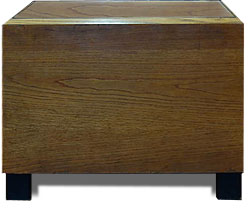
new velodyne


argi

"Επαγγελματίας"
Μηνύματα
30.020
Reaction score
6.881
Απάντηση: new velodyne

Velodyne introduced their series II subwoofer line in the fall of 1988, and it seems timely to review their largest, most powerful unit, the ULD-18. As the line's flagship, this Velodyne subwoofer represents the most sophisticated and expensive system offered by the company. It is sold as a system, complete with driver, enclosure, amplifier, control unit, electronic crossover, and servo cable and circuitry. Velodyne's unique servo circuitry, manufacturing techniques, and aggressive sales technique emanate from the company's designer, David Hall.

In a short five years, Velodyne has aggressively marketed five subwoofers spanning a price range of $645 (the VA1012) to $2595 (ULD-18), and distributed the products widely. Velodynes can be purchased both in very high-end audio stores, such as Lyric High-Fi or Definitive Audio, and in chain stores in the Washington, DC area. Their dealers number 240, and exceed the total dealerships for the seven subwoofers reviewed in past issues of this magazine by Dick Olsher (Vol.12 No.1), J. Gordon Holt and John Atkinson (Vol.11 No.4), or Martin Colloms (Vol.10 No.2). They have been successful in selling a product that has long been considered a well-heeled audiophile's accessory. As I shall point out, the ULD-18's performance more than justifies this success.
The Last Crusade: Is Subwoofing Possible?
The lowest frequencies of the musical spectrum are filled with much of its raw energy. The double-bass, the pipe organ, and the bass-drum produce tremendous emotional power. The subwoofer's raison d'être is to enhance the performance of the main loudspeaker by adding accurate, low-distortion sound in the 20–100Hz region. Planar speakers (including electrostatics) have difficulty generating much output in the low-bass region without doubling or distorting. Panel systems, particularly small electrostatics, are limited in diaphragm excursion, and cannot move a great deal of air. In theory, the subwoofer should improve a general-purpose loudspeaker's performance by removing a major source of distortion from its range; freed from the constraints of producing low bass notes, they can play louder with greater dynamics. No wonder the most expensive loudspeakers come with large bass-driver towers.
Harry Partch, modern composer and inventor of musical instruments, put it best. The occasion was a recorded commentary of his building of musical instruments to generate profound bass. It was difficult for him to "share" the impact of these instruments via records. He lamented the general lack of "adequate playback equipment" which could convey the power of his huge, 6' bass marimba, the "Marimba Eroica" (Delusion of a Fury; A Ritual of Dream and Delusion, Columbia MS-30576, side 1). Partch quips: "In the right room acoustically, the Eroica is felt through the feet, against the belly, and, if one sits on the floor, it ripples through his bottom. It is very difficult to put on tape, and especially on records with any fidelity. Adequate playback equipment is absolutely essential, which means that the poorer generally are not privileged to experience a rippling through their backsides by an art form."
But cost has always been one of the tickets of admission to serious subwoofing. Unfortunately, the best subwoofers and their supporting amplifiers and crossovers are very pricey. The Janis W-1, a 15" unit, now lists for $795 without crossover or amplifier. Sound Lab makes a very exotic electrostatic subwoofer, the B-1, which lists for $6500 mono, $10,000 stereo, and uses panels that are approximately 7' by 4' by 4"! The Entec, another crossover/amp/servo systems approach like Velodyne's, costs between $1995 and $20,000/pair, depending upon the number of drivers. The Maggie/Crosby-Quad System, a noncommercial hybrid heard in Madrigal's Consumer Electronics Show display, uses the woofer section of a $3800 Magneplanar Tympani IV system. Stacked against these, the Velodyne ULD-18's "complete" $2595 price tag does appear more reasonable.
Besides cost, distortion has been the other Achilles heel. Subwoofers, like many dynamic drivers, are prone to large signal-distortion products in amounts greater than 10%, tracking the signal only as well as their voice-coil drives, elastic suspensions, and cabinet designs (acoustic suspension, transmission line, etc.) will allow. Dick Olsher, in Vol.12 No.1, found that these distortion products had disastrous effects on "finesse in bass response," which he defined as "speed, tightness, pitch definition, and resolution of bass detail." He dreamed of a subwoofer that would give him both "quantity" of low bass while also maintaining its "quality." This supposed tradeoff refers to subwoofer distortion, which increases rapidly as signal level increases. Sometimes, the distortion can be so objectionable that one can feel slightly ill (footnote 1).
Why did this problem occur if the subwoofer generates sound in an area where the human ear is notoriously insensitive? As it turns out, our ears are very sensitive not to the subwoofer's main signal, but to the unit's harmonic distortion products. A 30Hz marimba beat is felt as much as heard; its third harmonic, 90Hz, is definitely heard, however, and small traces will easily color male voices. If the woofer has 5% Total Harmonic Distortion (THD) at 30Hz, it means that a 90dB spl 30Hz note would produce a 64dB spl 90Hz note. Since the human ear is 10 times as sensitive to the 90Hz note, the sensitivity of the human ear unduly weighs the sound of the 90Hz distortion over the fundamental marimba sound (footnote 2).

Footnote 1: Larry Archibald excused himself and left an audition of an otherwise outstanding system at the recent June CES. He objected to a recording of low bass, in this case the Saint Sa;uens Symphony 3 ("Organ Symphony"). Apparently, deep bass (in this case 32Hz organ notes) can make him feel quite uncomfortable. Chuck Turigliatto, national sales manager of Velodyne, comments that he can feel bass "descending down his body" as the frequency goes down from 25Hz to 7Hz, and the 10Hz notes do induce quite a queasy feeling. I used a signal generator to drive the ULD-18 at 20Hz, and adjusted the peak-to-peak excursion of the cone to about ¼" (as Hall suggested). I placed my ear close to the woofer cone (not recommended!). I could see the cone moving, and felt a pressure in the air around my body. As my left ear got within 8" of the driver's center cap, I experienced definite sharp pain, even though I could not hear the 20Hz note! This means that I was encountering 120dB SPL sound levels, although was unable to hear any higher frequencies, indicating (to me) that the THD was well below 3%.
Footnote 2: Hall suggested an interesting test to illustrate my ear's sensitivity curve. I turned the ULD-18's enclosure over so the driver was facing upward, and poured a few grains of salt on the woofer cone. I again drove the subwoofer with a 20Hz signal, set the cone to 1/4" peak-to-peak excursion (using a Q-tip, a bit of Scotch tape, and a ruler), and listened. I could easily hear the grains of salt dancing on the cone, but was deaf to the fundamental 20Hz signal, although it was many dB higher in level!
 

argi

"Επαγγελματίας"
Μηνύματα
30.020
Reaction score
6.881
Απάντηση: new velodyne

Subwoofer THD will mar the performance of a very-high–quality midrange-treble unit, like Quads, Apogees, or Magneplanars. This was the main reason I did not use my earlier subwoofer (an RH Labs SB-1), despite its otherwise high quality, workmanship, and ability to put out huge amounts of deep bass. Hall's studies led him to believe that 0.5% THD is the maximum allowable distortion tolerable in a subwoofer. His "High Gain Servo" (HGS) circuitry is said to reduce distortion by a factor of 30. The ULD-18 is rated at 104dB SPL at 20Hz at 0.5%, well within this limit.

Design features
The Velodyne subwoofer is part of a system, so one doesn't have the "hidden" expenses of extra amplifiers or crossovers that might or might not work out. 12dB/octave crossover slopes and the 85Hz crossover point for low- and high-pass filters were selected as the best general match to most full-range systems. The ULD-18's enclosure, crossover, and amp have been optimized for one another, and are sold as a package. The ULD-18 is only sold as an optimized system, with its own 400W amplifier, error correction, and crossovers optimized for the particular driver in each unit (serial numbers of subwoofer enclosure and remote unit must match!). This means that the audiophile isn't faced with identifying, purchasing, and trimming in the right crossover with the right slopes, and right high- and low-pass frequencies and right amplifier. It's all done at the factory! In fact, the Velodyne's amplifier will not drive the woofer without the servo mechanism in place.
Hall found that every detail of design and production was critical. Reducing distortion at 20Hz means optimizing cone stiffness (polypropylene proved too flabby), magnetizing the speaker correctly, individually reducing the standing waves in each driver by watching it perform, electronic and mechanical hand-tuning of each system manufactured, and sealing every screw hole with special glue so there is no air leakage. Like balancing a tire, small weights are applied to each loudspeaker and small holes are punched in the cone to break up standing waves. This means each ULD-18 is virtually handmade. Final adjustments are made within each remote unit, so one can't simply pull another untrimmed remote electronics off the shelf to replace one in the field.
But error correction doesn't stop with the physical setup of the subwoofer—it continues during every second of its operation. Velodyne's error-correction accelerometer samples cone movement 3500 times per second. The resulting data on the cone's real-time behavior are further refined by Velodyne's special HGS system. The Velodyne 400 amplifier becomes part of this correction loop, with 30dB negative feedback reducing distortion in the amplifier-speaker system.
Velodyne has refined the concept of motional feedback. Hall mounts an acceleration-sensitive piezoelectric pickup on the voice-coil form. It generates a tiny voltage proportional to the rate of change in velocity of the cone. An additional amplifier, mounted in the subwoofer itself, sends this voltage back to the HGS system. Additional circuitry in the remote box compares this analog of the acoustic output of the woofer with the command signal coming into the Velodyne remote from the preamp. When there is deviation, the controller alters the drive signal to the subwoofer's amplifier. Rather than the subwoofer's acoustical output being distorted, its input signal is pre-distorted in such a way that the acoustic output from the ULD-18 more closely matches the source signal.
Sampling acceleration data is a feature of the Velodyne system. David Clark's review of the Velodyne ULD-15 for Audio (Vol.71 No.11, pp.78–90)) best explained the advantages of acceleration-sensitive pickups. Briefly, the rate of change (acceleration) of a subwoofer coil can vary greatly in the profound bass range; it is most critical for the subwoofer cone to maintain the same speed variation from 20–100Hz ("a flat frequency response for a small radiator...results from equal peak acceleration at all frequencies") than simply to have a capacity to move (large long-throw capacity). The HGS system depends on the accuracy of error data, which becomes the critical factor in keeping the distortion down. Other manufacturers use servos and accelerometer pickups in their price-no-object full-range speaker systems, such as the $50,000 Infinity IRS (Series V). Infinity uses one of the 12" woofers in each of the IRS Beta's two bass towers to derive the servo signals.
The HGS demands a high-gain loop, as as much as 30dB of negative feedback must be applied, and the actual speaker amplifier has to be powerful (400W) to handle any compression being applied to the input signal. A "compensation" circuit must be used to prevent the system from turning into an oscillator, where the servo signal runs away with the system. In fact, the owner is warned that the speaker cable leads from the Velodyne remote box (where the subwoofer's power is generated) must not be inverted when plugged into the subwoofer. Additionally, a gain-compression or limiter circuit is used to prevent the amplifier from going into clipping (or the subwoofer cone from jumping out of the coil gap!) by receiving too much input signal, when one leans too heavily on the volume control.
Obviously, a clipping amplifier doesn't respond to error correction. For example, the bass drum beat on David Wilson's Winds of War and Peace easily drove the Celestion System 6000 into serious, noisy clipping, but not the ULD-15 or ULD-18, the Quad/Velodyne system being able to play this passage louder than the non-servo subwoofer. The gain compressor circuit will signal the comparator circuitry to shut down the subwoofer's power amplifier for 5 seconds, just as it will shut off if it detects that the servo interface cable is disconnected or the power amplifier's power supply has developed problems.
Besides costing more than the Series I, the Series II line added a number of critical advantages, including a smarter, more rugged protection circuit for speaker and amplifier, with automatic shutdown for a short, open circuit or input overload. This reduces the likelihood of woofer damage if one reverses the speaker-cable terminals at the subwoofer, turning the servo into a powerful oscillator. The cable carrying the servo feedback to the system's amplifier was simplified from a DIN cable to a simple phono cable, and the crossover components are now mounted in a plug-in gold-plated carrier, allowing for quick changes of crossover frequencies and slopes. The built-in amplifier is now run in the more efficient Class-G mode to reduce heat and provide the increased voltage swing needed for the signal comparator, gain compressor, and protection circuits.
Description
The original ULD-18 was Velodyne's first product. The enclosure size was modeled on a published design of an enclosure using an 18" JBL woofer, but one inch smaller in each dimension. Philips had designed a servo circuit to make a small woofer sound like a large one; Hall refined the circuit with special signal compression and protection, in order to make a large woofer sound even better. Yet he and his sales representative found the first 18" Velodyne subwoofer unwieldy to take on the road for dealer demonstrations. He went on to design the ULD-15 in a much smaller enclosure. The higher compression of air necessary for the '15 produced more nonlinearities than found in the '18, and this necessitated a more sophisticated HGS system. The ULD-15's servo was then incorporated in later models of the '18.
Today's Series II ULD-18 remains a massive, 105 lb sealed woofer box, finished on all sides in oiled walnut or oak veneer. The woofer faces down, a "floor-loading" position. Even though the cone diameter is only 3" greater than the ULD-15's, the '18's enclosure is more than double the size (5.8 cubic feet vs the ULD-15's 2.6 cubic feet) and almost twice as heavy (105 pounds vs 57 pounds). The '18's 1" wall thickness exceeds the ULD-15's by 0.25". Setup reminded me of JGH's description of the 10 hours of "sweating and cursing" required to find the best location for two 120-pound Nelson-Reed 1204 subwoofers (Vol.11 No.4, p.122).
 

argi

"Επαγγελματίας"
Μηνύματα
30.020
Reaction score
6.881
Απάντηση: new velodyne

</IMG>
</IMG>Subwoofers
Velodyne ULD-18 & ULD-15 subwoofers:
Page 3
Just the act of adding one more huge box to a room already crowded with two large planar speakers can precipitate a decorating crisis and serious domestic friction. Like it or not, the ULD-18's WAF (Wife Acceptance Factor) may be lower than its sonics deserve. After all, the ULD-18 is as big as a small freezer!
Actually, the ULD-18's 5.7-cubic-foot enclosure would have been larger, but the technology involved has kept the size down. Its legs have rollers that allow a normal mortal to move it around without scratching the floor. There are the single pair of 5-way binding posts and a single RCA jack for the servo line on the unit's bottom. A flashlight helps while plugging in the speaker cable, because it is critical to keep the red terminal of the Velodyne amplifier connected to the red terminal of the subwoofer box (if the cables are reversed, deafening low-frequency feedback occurs in massive amounts, and can damage the speaker if continued for more than a few seconds). Aficionados can replace the rollers with Tiptoes for ultimate stability.
The remote is a black, finned box, with a power switch and level control on the front panel and RCA jacks, a pair of 5-way binding posts for a single speaker cable, and a single RCA jack for the servo line on the back panel. No tape-monitor output is provided on the Velodyne remote, so an external box would be required if you are using an integrated amp or receiver, rather than a preamp. Inside the unit, a single power supply drives all the electronics, including the bridged power amplifier. This "remote" unit is best placed next to the main system's preamplifier, as it divides the signal to all the power amplifiers. A 24' RCA cable is supplied with the system, and serves as the line for the servo signal.
The servo works soon after the unit turns on. One can tap the woofer cone with the servo off and on, and the resulting sound is very different. The servo-activated cone is stiffer and does not make the hollow "thunk" it does when outside the servo loop. Each time the Velodyne system is turned on, it makes a noticeable "pop" as the servo trims in the system. Years ago, this sound meant I had an amplifier with a turn-on or turn-off transient, typical of a prototype unit a manufacturer hadn't put the finishing design touches on. With the Velodyne system, this sound means you're in business.
The crossover and phase adjustments for the Velodyne amplifier are controlled by a series of seven soldered-in resistors on a carrier, which plugs into a socket on the back inside panel. An optional Velodyne data sheet explains the method of changing the crossover high- and low-pass frequencies, the slope of the high-pass filter, and the phase of the system. I found that having additional sets of resistor carriers (available from the dealer) for different frequencies and phase helped with the review; it could also help an owner who buys new full-range speakers. Once set up, plugging carriers in is easy and safe (with the unit turned off, of course). Soldering on the small card is tricky, for the plastic may melt at the same time the solder does.
The Velodyne system is sold as a single woofer system, and the remote unit sums a signal to go to the single subwoofer. Using two woofers requires two remote boxes, with right and left interconnects from your preamp going to the right channel of each Velodyne remote.
Set-up
I had auditioned subwoofers before, and had always come back for more subwoofing, despite the following drawbacks. I did not enjoy: the need for an extra amplifier; the sense that bass information came from a different location than the rest of the music; the added colorations in the midrange; or the added clutter in my living room. Despite wood floors, different amps, and using two different electronic crossovers, I could never get the bass to play loud enough without producing all the ills of poorly controlled subwoofing—room overhang, echo, muddied midrange, and loss of imaging.
Moving the 105 lb cabinet around my newly-finished floors was best handled by two people to avoid scratches. The ULD-18 was rolled to two locations. First, keeping in mind the WAF, I "hid" the speaker enclosure behind the sofa, off to the right and behind the listening position. Signal-generator sweeps revealed that location to produce low levels of 20–30Hz bass. Also, it was 15' from the Quad ESL-63s, and the phase and timing differences muddied up the midrange and weakened the power and definition of the bass. Moved to a central spot between and one foot behind the Quads, the subwoofer "disappeared" sonically from the midrange, introducing no colorations from the crossover. I was surprised, because this location meant that the subwoofer was placed next to the back wall, which could have produced heaviness and unwanted bass reinforcement. The ULD-18 remained unobtrusive, only coming to life when deep bass information was present. I also discovered that the floor was not level, which meant that the ULD-18's wooden roller-wheels rattled during loud bass passages (the Dafos drum crash). Wadding paper under the loose wheels quickly stopped this annoyance.
Once the crossover slopes and frequencies had been chosen by plugging in the appropriate carrier jig, the level control on the outside of the remote was adjusted. I had chosen the nominal 85Hz, 12dB/octave setting shipped with each ULD-18 for use with the Quad ESL-63s. (I also tried a 60Hz crossover point carrier, but this muddied up the upper bass and low midrange.) I listened to male announcers on FM radio for starters, and found that a natural bass tone was achieved by setting the Velodyne's level control to about 8:30 (using the settings like a clock face). Further listening to double-bass recordings confirmed that was the most natural setting. Cranking the control higher added unwanted upper-bass colorations.
Listening tests
Listening to the Velodyne for the first time was dramatic. The ULD-18 system came on with a "pop" from the subwoofer indicating that the servo had set itself. I put on David Wilson's new CD, Winds of War and Peace, which begins with the "Liberty Fanfare." The Velodyne remained silent for the first 55 seconds of the CD, but then burst into life as a bass drum joined the orchestra. As I heard the solid, gut-punching bass note, I felt the wood floor flex under my feet! The impact of the floor shock reminded me of the shift caused by a Richter 4.5 earthquake that had hit the New York area 22 months before. Yet there were no unnecessary overtones, no overhang, no disturbance of the midrange or treble sounds, just that big bass note with its clean, well-defined leading edge. All the overtones of the bass drum were there, as I had not heard them before, although I was surprised that the drum could be so closely miked.
 

argi

"Επαγγελματίας"
Μηνύματα
30.020
Reaction score
6.881
Απάντηση: new velodyne

</IMG>
</IMG>Subwoofers
Velodyne ULD-18 & ULD-15 subwoofers:
Specifications
Sidebar 1: Specifications
Velodyne ULD-18 subwoofer system: Down-firing, floor-standing, dynamic, sealed-box, self-powered subwoofer with separate electronic crossover and servo-controlled power amplifier system. Driver: one 18" cone, &frac34;" linear travel, with accelerometer and preamp. Nominal input impedance: 20k ohms. Amplifier power: 400W continuous. Input sensitivity: 300mV for maximum output. Crossover: Independently selectable high-pass (36–212Hz), low-pass (60–193Hz) frequencies and phase (0 or 180° phase) via changing soldered-in resistors on a plug-in seven-terminal "header" socket by dealer. High-pass slopes (6–12dB/octave) can be also set. Unit under test shipped with nominal, standard 12dB/octave high-pass slope and both high- and low-pass frequency set at 85Hz. 15Hz subsonic filter point used with the 85Hz crossover. Frequency response: 18Hz–85Hz, ±3dB; 104dB at 20Hz with less than 0.5% THD.
Dimensions: "remote" power servo control unit: 17" W by 3.5" L by 11" D. Weight: 15 lbs.
Cabinet dimensions: 23.5" W by 31" L by 21.75" LH, 5.77 cubic feet. Weight: 105 lbs.
Finishes: walnut, oak, black; beveled hardwood edges, hardwood legs with concealed rollers.
Price: $2595 (1989); no longer available (2010). Velodyne ULD-15 subwoofer system. Similar system using 15" cone, 5/8" linear travel. Frequency response: 18Hz–85Hz, ±3dB, 104dB at 20Hz with less than 1% THD.
Cabinet dimensions: 17" W by 22.5" L by 18.25" H, 2.59 cubic feet. Weight: 57 lbs.
Price: $1795 (1989); no longer available (2010). Both: Warranty: 2 years, parts and labor. Approximate number of dealers: 240.
Manufacturer: Velodyne Acoustics, Inc., San Jose, CA 95112 (1989), 345 Digital Drive, Morgan Hill, CA 95037 (2010). Tel: (408) 465-2800. Fax: (408) 779-9208. Web: www.velodyne.com


Μηνύματα
3.469
Reaction score
150
Καινούριο? Ωρέ θα μας τρελάνεις? Αυτό το είχε ο θείος μου ο Φάνης στο ιππικό!


Μάλλον το κεφάλι σου έχει clock issues τώρα με τις ζέστες και βγάζει jitter!:137:
 

Μηνύματα
3.345
Reaction score
462
Απάντηση: new velodyne

Κατι σκαμπω ,κατι σαν μπαουλο με ποδια ειναι ρε Αργυρη.Αυτο εχει μεσα μεγαφωνο η αποθηκευτικο χωρο:142::142:?Κλειδωνει τουλαχιστον?
 

argi

"Επαγγελματίας"
Μηνύματα
30.020
Reaction score
6.881
Απάντηση: Re: new velodyne

Καινούριο? Ωρέ θα μας τρελάνεις? Αυτό το είχε ο θείος μου ο Φάνης στο ιππικό!


Μάλλον το κεφάλι σου έχει clock issues τώρα με τις ζέστες και βγάζει jitter!:137:
ρε παλαβωμενο
το σαμπ θα ξανακυκλοφορησει τον σεπτεμβρη
και δεν εβρισκα αλλη αναφορα αλλου
πιτσοπαιδι
ε
πιτσοπαιδι
 

Μηνύματα
3.345
Reaction score
462
Απάντηση: Re: new velodyne

Καινούριο? Ωρέ θα μας τρελάνεις? Αυτό το είχε ο θείος μου ο Φάνης στο ιππικό!

Εκει μεσα φυλαγαν τα βολια και την μπαρουτι!!:142:


Μάλλον το κεφάλι σου έχει clock issues τώρα με τις ζέστες και βγάζει jitter!:137:
ΟΛΕ!!:142:


Staff online

ΣΤΑΤΙΣΤΙΚΑ

Threads
177.395
Μηνύματα
3.078.623
Members
38.695
Νεότερο μέλος
Antonis N.
Top