
Why cable reviews are almost useless..

Κώστας Φ.

Truth hurts. Here's a teddy bear.
Μηνύματα
8.978
Reaction score
895
Ένα σχετικά παλιό αλλά πολύ ενδιαφέρον άρθρο που ανακάλυψα πρόσφατα - απο τον Mark Wheeler του TNT-Audiο.
Το κάνω copy ολόκληρο γιατί το άρθρο είναι γραμμένο με μεγάλα bold γράμματα στο TNT και κουράζει.
 

Κώστας Φ.

Truth hurts. Here's a teddy bear.
Μηνύματα
8.978
Reaction score
895
Απάντηση: Why cable reviews are almost useless..

BITS OF WIRE & PIECES OF STRING: Why cable reviews are almost useless

Charm Cable Constructions Inc bring to the market 3 cables spearheading their exciting new range of bits of wire with unfeasably butch plugs that'll unscrew the sockets on yer average integrated amp quicker than a Snap-On torque-wrench. The Upquark and Antineutrino interconnects and the Lectron speaker cable redefine audio system synergy as much as they they rewrite subatomic particle physics lore. TNT authors have recently taken a new look at some of the established doctrines of domestic audio (the kind that make pro-audio workers laugh) including Goeff Husband's scrutiny of the vta debate and Hartmut Quaschik's September 2004 look at the Linn LP12, and these ramblings do not promise as much of a paradigm shift.

So today we take a look and listen to "cables", as they are pretentiously termed in the audio business (previously "cables" were used to secure ships to docksides or latterly carry telephone signals accross oceans) or "bits of wire" as one of my cynical music-loving friends more accurately describes them.

Particle physics experiments are usually undertaken by colliding atoms of one element with subatomic particles from another element in VERY BIG bits of laboratory equipment that are the lab equivalent of top-fuel dragsters in a world of economy hatchbacks. And yet, even these have been described as like colliding 2 wristwatches together and then hoping to learn how they work from observing how the bits fly apart. So learning about particle physics is jolly difficult. But hifi cable manufacturers seem to know stuff about particle behaviour that are as yet unpublished in Nature or Scientific American.

A synchrotron (sometimes called a synchro-cyclotron) is a circular accelerator which has an electromagnetic resonant cavity (or perhaps a few placed at regular intervals around the ring) to accelerate the particles, unfortunately these have to be very cleverly designed because everything has an irritating habit of becoming non-linear at very high speeds (like several motorcycles I have owned).
According to the Fermilab Cyclotron site, TESLA technology Superconducting accelerator structures of niobium, the so called resonators, are components of the future linear accelerator. So that's clear then, a big lot of money is needed to make stuff out of exotic materials that operate at ridiculous temperatures in order to learn what electrons and their ilk do on their days off (because these are hardly the normal workaday activities of the average subatomic particle zooming around in a cup of coffee).

Hifi cable manufacturers should take a year out and go tell the physicists how subatomic processes work because they could save the millions of euro that the new synchrocyclotron is costing at Cern (Centre Européen pour la Recherche Nucléaire not the Cerne Abbas giant who is a prehistoric chalk carving of a giant naked man with a large erect penis on a hillside near the village of Cerne Abbas in England), even the Swiss Proton Users' Group (and who'd admit to owning/driving a Proton, even in Switzerland?) singularly fail to mention audio cables anywhere on their website. How can two so mutually interested pioneering areas of science so fail to recognise each other's contributions.


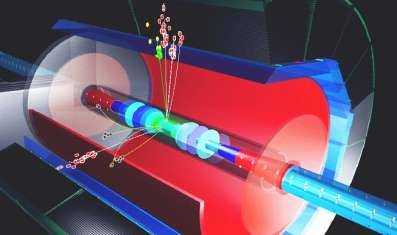
In the center of the future TESLA detector are various detecting devices to trace the paths of the particles: the vertex detector (green), tracking chamber (red), electromagnetic calorimeter (blue) and hadronic calorimeter (black). The particle bunches are made up of electrons and positrons which hurtle in opposite directions through the beam pipe (blue), entering the detector from both sides and colliding in the center of it. The results of this "collision event" are symbolized by the colored tracks and points (Source: DESY Hamburg). This is splendid research that will surely change hifi cable construction in the future, so it must be worth every penny.

Whenever we discuss bits of wire, sorry, "cables", we are right back in the territory of the 70s subjective vs objective debate; one which still rages among certain folk. There is a perfectly valid psychological explanation for the heat of these debates that has nothing to do with audio, art or science. Good science and good engineering are largely a matter of amassing sufficient repeatable data to be able to draw hypothesis and use these to make reasonable predictions of what might result from a certain action. This must be checked by experiments that test these hypotheses. Very simple really, one might think.

Repeatable personal observation provides us with uniquely validated evidence more than the rhetoric of church, state or audio advertisement. But there are those who cloak themselves in the language of science who insist that phenomena do not exist if they cannot explain them in their own terms, rather like the tobbacco companies who until recently insisted that no causal link could be proved between smoking and lung-cancer, may have been a technically accurate statement at the time but was a lie in any other conventional phenomenological encounter with evidence, and was illogically extended to the hypothesis that therefore cancer was not caused by smoking. For example there are still those who insist that we cannot hear differences between bits of wire in audio systems because they have cannot envisage how such differences could exist. They use logical argument to override sensory experience, which is how many of us manage to spend years living unsatisfactory lives because we ought to do what we are doing, because we have been told that is the way to do it.

To me those objectivists who refute all cable differences are merely taking a position similar to the Rennaissance religious backlash against new knowledge of the solar-system. The objectivist position is equal in evidence base to any other religious faith.

The Subjectivists, on the other extreme, know that copious doses of money & snake-oil & pixie-dust (mined until quite recently in the English county of Cornwall, whose residents don't call themselves English, but Kernow, where it is still called Piskie-dust) will transform the electrical signals entering & leaving amplifiers from ignorant neanderthal electrons leaping from cave-to-cave (electron holes) into elegant sophisticates possessed of the savoire-faire of soundstage & screen.

The cable-charmers imbue bits-of-wire with mystical magical properties not yet known to science, but familiar to spiritualist mediums. This subjectivist position ranks alongside faith healing in its adherence to an empirical evidence base backed by academic rigour.

Now I know that I have angered both the Objectivists and the Subjectivists in equal measure. They are both suffering from the same psychological condition: an inability to cope with uncertainty. Indeed, they may suffer from a fear of uncertainty. To both groups, "uncertain = unsafe". The objectivists want to measurable-repeatable readable test results that clearly state that there is a difference between A & B and that the difference proves that A is better than B and therefore might justify higher unit cost. The subjectivists need to know that they will hear that A is better than B because several other people say they have heard that A sounds better than B and that there is unlikely to be an even better C because only A has ingredient/process X.

In this postmodern age there is an argument that all stories are equally valid and equally true; that there are no metanarratives (of which any doctrine is but one attempt) and that each of us carries our own unique story including our own unique engagement with the world. So my measurements are as good as yours and your pixie-dust is as good as mine. So anything I write about any piece of audio equipment is just my story and you may as well not bother reading it. Equally I shouldn't bother writing it. Except that I am driven by nearly 30 years of experience of reading the audio comics and finding that much of what I read doesn't correlate to my own experience in any way. Much of it seemed to have been written from a point of view of vested-interest, whether material or emotional, and some from sheer gullibility both objectivist and subjectivist. Experienced audio readers gradually learn whose opinion they trust in what area, but neophytes can pay a very high price for these lessons, both in finance and sound quality; I was lucky to be impoverished enough to learn by DIY experiments and solutions.
 

Κώστας Φ.

Truth hurts. Here's a teddy bear.
Μηνύματα
8.978
Reaction score
895
Απάντηση: Why cable reviews are almost useless..

My long history in encounters with bits of wire began as a 15 year old in 1974. A friend & I were experimenting with any aspect of our audio arrangements we could think of as we had no money, no sense, and an excess of time because the girls that we liked had no interest in us. Faffing about with speaker wires cropped up as part of our desperate efforts to make silk-purses from the sows-ears our meagre incomes could buy. We began simply with the idea that thicker speaker wire would offer less resistance and therefore allow a better relationship between the amplifier and the speaker load. We were only basing this on basic school physics lessons and poorly understood library books. We were surprised to hear a big difference from a couple of lengths of 20A ring-main cable (2.5mm^2 solid core with earth drain pulled out) compared with the thin figure-of-8 "bell-wire" supplied with speakers. Naturally this prompted further experiment with 30A cooker installation cable making even better bass, which we simply attributed to better damping factor, knowing of no other parameter.Then my friend obtained a large quantity of (used) TV downlead and we tried this, not in it's coaxial centre-hot, screen-return configuration, but centre & screen joined at both ends and 2 runs to each speaker. We were amazed by the results on every speaker we tried them. We followed this by removing the crossovers; mounting x-over close to the amplifier and tri-wiring to the drivers, based on not having any more ideas of what else to do with our vast cache of 75ohm downlead. We assumed that the improvement we heard was due to further impedence reduction and the fact that we had hard wired every connection except the back of the amplifier, because we couln't afford to buy 12 pairs of connectors.

Then in August 1977 HiFi News & Record Review published a translation of Jean Hiraga's seminal La Nouvelle Revue du Son article on cable-quality and sound-quality "Can we hear connecting wires?". The impression that article made was such that I can remember where I was (on a boat) when I read it. It amazed me that someone with access to really good equipment could hear cable effects when we thought these effects were entirely due to our cheap used junkers, homebuilt speakers and adapted PA & instrument amplifiers. We had thought sound differences between wires was due to the inadequacy of our equipment, not to the gilding of our ears, but now we knew we had been elevated to the ranks of the golden-eared, and still just schoolkids too.
This psychological response is a behavioural reinforcer:
we can hear cable differences therefore we are special;
everytime we hear cable differences we feel special;
to hear cable differences is to feel special.


This is a generation of people who are the beneficiaries of improving widespread education, but who were raised and educated to believe that what is written is of more value than what is personally experienced; that somehow an opinion that has made it into print on paper has greater weight than our own sensory experience. The most valid shadows on the walls of Plato's cave are those written about and printed. At school we are taught that any opinion we expressed had to be validated by references to opinions printed by someone else earlier. My day-job occasionally involves research and writing, and editors won't allow statements unsupported by a similar previous opinion; paradigm shifts are a tough call in this environment. One is supposed to be able to refer to someone else writing something similar earlier.

One manufacturer who wanted knowledge of the widest range of system contexts before deciding whether to market a prototype, used to loan me bundles of experimental cables in exchange for feedback. I also suggested design ideas to him that I was then able to try as prototypes. In the process I was lucky to undergo a very steep theory-into-practice learning curve, without spending hard-earned cash. For all those armchair theorists & commentators this is a salutory lesson in the realities of audio development. Something as simple as a piece of wire may completely defy your carefully constructed theory, despite experience of many ready-made cables.

One such opportunity was to try four wires of equal length and identical plugs featuring two alternative constructions and two alternative conductor materials. This enabled a reasonable attempt to find out what-affects-what in various systems. There were also some additional variations on each theme to spice the experience. I tried them in my own system and in some very different systems belonging to friends.

In each of two conductor materials there was a choice of multistranded or solid-core of similar total cross-sectional area. There was also a much thinner version of solid-core in one of the two materials. To disguise the identity of the manufacturer I will name them only by letter. Conductor type A is a very popular type used by many suppliers and conductor B in expensive applications by very few makers.

The results were clear and unambiguous: the successful application of a type of construction was system dependent. Conductor material was not system dependent.

Construction also made a distinct contribution that which remained similar throughout, but advantageous in one system and less so in another context. In interconnects the construction type was most important in terms of system compatibility. "Flat Earth" systems (for example Linn & Naim or Pink Triangle & Exposure, which dates when these experiments took place) needed multistrand interconnects, whereas high-end Sound Practices type all valve (tube) systems needed solid-core conductors. This was a more significant system synergy consideration than conductor material type. Any system outside these two very broad categories was unpredictable. A system with a Croft Micro (valve) pre-amp and a big Rotel solid-state power-amp needed a solid core pre-to-power interconnect but a Naim NAC42 pre-amp feeding EAR509II (valve) only sounded right with multistrand interconnects. No obvious patterns emerged though.

Materials quality seemed to affect the type of sound, its voicing and characteristics, but not its system compatibility. If solid-core silver suits a system better than multistrand, then solid-core copper will suit the same system better than multistrand. In our tests conductor B always outperformed conductor A once the preferred construction was identified in any application, but the wrong construction choice was always obvious whatever the material. The biggest lesson was that materials quality could only be judged after the construction type for that system was identified. Given that different manufacturers often favour different construction characteristics, meaningful comparisons between brands are impossible outside the context of each individual system.

Wires do make a difference, but not much. My only BIG DIFFERENCE experiences have been loudspeaker cable, nearly always with very weird construction. Each example would be enthused over by another reviewer and yet dreadful in my system. One occasion rendered a whole system unlistenable and I thought something was horrbly and expensively wrong with the amplifiers. Investigation proved the high capacitance cable reactance was a serious mismatch for the minimalist crossover. More indcuctive dumbell section (Naim NACA4 at about £3 per-metre in those days) sounded OK in that system, but the rave-reviewed £50 per-metre flavour-of-the-month sounded like tortured cats through megaphones. This does not make it a bad cable, just unsuitable for that system.

For loudspeaker wires I suggest you keep it simple, use straightforward construction types of low resistance and avoid highly capacitive or inductive types. Then stop obsessing about it. That magic synergistic connection between your present amplifier and present speakers will look like a horribly expensive mistake when either gets upgraded. Biwiring does make a difference with some crossovers but a fully active system is the only way to go really.

Conclusion
Writing objectively about bits of wire is impossible. Reading about bits of wire is at best ambiguous and at worst misleading without comparable contexts.
From late Summer bats used to fly into my garden every evening, and along the nearby river feasting on the insects swarming in clusters there. They haven't appeared since developers demolished some old industrial sheds 1/2 mile from my garden, but when they return I'm sure they'll bring some pixie-dust that'll make me hear all the stuff we're supposed to hear. When it happens I promise I'll sell it on the web so you can hear it too.

I haven't had that "everything snapped into focus" moment ever in any parameter with any type of gear... yet...perhaps I just didn't take enough drugs when I was younger? Cables are useful and do make a difference but cables just aren't that important to anyone whose income does not depend on their advertisements.


LINK


Μηνύματα
5.581
Reaction score
298
Τη βιβλιογραφία για το τι συμβαίνει και το τι δεν συμβαίνει με τα καλώδια την έχω δώσει κατά καιρούς. Όποιος θέλει, ψάχνει, βρίσκει, διαβάζει και ξεστραβώνεται. Τα υπόλοιπα κουμάσια παίζουν τα παιχνιδάκια τους, τα ψιλικατζήδικα - και οι χάνοι κάνουν αυτό, εφ' ώ ετάχθησαν: χάφτουν.
 

Costas Coyias

Επίτιμο μέλος
Μηνύματα
26.282
Reaction score
23.697
Seven Shiny Pennies
From Audio Basics, Volume Seven, Number 10, October, 1988

Do you want these sevens shiny pennies or that old tarnished quarter?

Everyone remember trying that little trick on their favorite three year old at some time, and knows that the little three year old will take the seven shiny pennies every time!

Do you want a 12" woofer or an 8" woofer?

Do you want 80 watts or 70 watts?

Do you want eighteen bits or sixteen bits?

Do you want these real thick gold plated cables or those old skinny cables?

Do you want three laser beams or just one laser beam?

Do you get the message?

Friends, a significant portion of the market will still take those "seven shiny pennies" every time, as adults – and a significant portion of the sales efforts being made out there is to reinforce that ignorance and to sell you those pennies – for the price of the quarter, of course.

I get sick whenever some polished yuppy salesman starts talking to me about "perceived value." That is exactly the same as the old piece of advice that the best way to get rid of your garbage is to wrap it in a fancy package and leave it on the seat in the bus. Beware when the sales pitch starts talking perceived value - the con man is simply trying to reinforce your idea that the shine on the pennies is really nifty and desirable.

Did you ever wonder how this country can consistently elect a president from one party, have the Senate's control much closer balanced, have the control of the House remain in the hands of the other party, and find, at the local level that your elected officers have no real correlation with who is in power nationally?

That, dear readers, is an easy question to answer. It is simply that as you move further away from the great national offices, less "marketing" of the election takes place. At the national level, elections are almost wholly determined by marketing efforts these days - an ideal situation to put retired second rate movie stars into office. As you move closer and closer to home, the less money is available for the professional marketing and packaging efforts, and the more the elections are determined on actual substance. At the local level, almost no marketing takes place at all (it costs too much), and thus you get to elect your officials based upon your knowledge of them personally and the real local issues of interest to you.

It is no surprise that national and local election results don't corollate. At the national level you have been marketed to death, at the local level you still have a chance, if you choose, to think.

Remember that Van Alstine's definition of marketing is, "Using fraud and deception to sell crud to fools."

My regret is that because of the significant negative education going on in all fields of endeavor these days, I have to take more and more time combating marketing brainwashing and thus less of our time and resources are available to inform potential clients about the virtues of our efforts.

For example, what do you say when a customer calls asking if you have speakers with 12" woofers? Even the giant B&W 808's have 30 mm woofers — not quite 12". When you tell the caller that no, your best speakers do not have 12" woofers but they do play outstanding bass and he responds by informing you that if the speakers don't have at least 12" woofers then they can't be any good and thus there is no point in coming out to listen, the pressure is there to start lying to the customers, just to make the sale.

Too many "readers" want me to tell them what magic cable and speaker wire to use! They don't want me to be honest and explain that there is no correlation between cable quality and price. They certainly don't want me to inform them that the only differences between the "sound" of various cables is the way the real electrical characteristics of the cable (the resistance, capacitance, and the inductance) loads the driving source. They don't want me to say that any sonic differences can be replicated with 10¢ worth of resistors, capacitors, and inductors wired across the cable. They don't seem to even want to know that if an amplifier is not load sensitive, the characteristics of the cable won't matter at all. None of that good electrical engineering advice is any fun at all.

Magic is a lot more fun and is much easier to understand. So, I keep getting call after call and letter after letter asking me only what brand of magic cable I recommend. And, when I respond, the answer is perceived that I don't like magic cables. Wrong again! I don't like fraud! I don't like products that are represented and priced to have some mystic quality that does not exist and that the supplier knows does not exist. I don't like the fact that the entire high end and mid-fi market has taken up selling high priced cables as a way of making a quick buck and convincing you that their shinny pennies are fair trade for your quarters.

I don't like magazine reviewers mindlessly listening to and evaluating magic cables and wires in endless nauseating reviews without ever thinking about what is going on, what are they really hearing (or not hearing) and why. The concept that most electronics are excessively load sensitive and that changing the load changes the sound seems to be an alien thought, too hard to understand. The concept that if the cable changes the sound, then the real problem is the source driving the cable is never discussed. Nobody is willing to stand up and shout "Bullshit."

So, when I demonstrate at a show, obviously using standard cables and interconnects, I get to spend my time explaining why the sound was so good with "bad sounding" wires. Far too many of the visitors to our room were so brainwashed that they never understood that the sound was good because the equipment was not screwing up the source material, because I had done an adequate job of getting rid of the worse of the room acoustic problems, and because the brand and cost of the cables did not matter much.

The marketing experts have been doing far too good a job. Have some more pennies.

Frank Van Alstine

LINK


Costas Coyias

Επίτιμο μέλος
Μηνύματα
26.282
Reaction score
23.697
Indeed, during these comparisons (without changing cables), some listeners were able to describe in great detail the big differences they thought they heard in bass, high-end detail, etc. (Of course, the participants were never told the NAUGHTY TRUTH, lest they become an enemy for life!)

John Dunlavy

LINK
 

Κώστας Φ.

Truth hurts. Here's a teddy bear.
Μηνύματα
8.978
Reaction score
895
Απάντηση: Re: Why cable reviews are almost useless..

John Dunlavy

LINK
:bravo:

Έχει και συνέχεια:

"Reliable studies have conclusively proven that "audible differences"
perceived during poorly-controlled subjective listening comparisons
almost invariably vanish when proper "listening controls" are
instituted. Without proper "blind" controls, listening evaluations
almost never yield any relevant or reliable information regarding
possible differences between cables. (However, such controls must be
designed to effectively eliminate "listener stress" - claimed by some
who do not believe in the relevance of blind comparisons.)

In attempting to eliminate (or reduce) the effect of such perceived
intimidation, we have devised an interesting "deception technique",
wherein we pretend to change cables, letting listeners believe they
know which cable they are hearing, when in reality they are hearing
the same cable throughout the entire session. Interestingly, all
participating listeners invariably continue to identify differences
they believe exist, even though they have listened to the same cable
throughout the evaluation.

An alternate version consists of actually changing cables but mixing
up the order, permitting listeners to believe they are listening to a
particular cable they have earlier identified as possessing certain
audible differences - when they are actually listening to a different
cable. Again, their choice of descriptive adjectives always tracks
the identity of the cable they thought they were listening to, but
were not!

Of course, as I have reiterated many times, it is indeed possible to
sometimes identify barely perceptible differences between
cables. These are almost always traceable to cable/equipment interface
problems, etc., and have always proven to be measurable, quantifiable
and explainable, using well-understood theory and technical knowledge,
along with adequate measurement tools."
Cable nonsense -- article #2

Cable nonsense -- article #3
Cable nonsense -- article #4


Ολόκληρη η συζήτηση εδώ - αν και τα post του Dunlavy είναι τα πιο ενδιαφέροντα απο όσα κοίταξα. (Loooong thread. You've been warned.)


Κώστας Φ.

Truth hurts. Here's a teddy bear.
Μηνύματα
8.978
Reaction score
895
Απάντηση: Re: Why cable reviews are almost useless..

Άντε να χαθείτε ρε. :happy_9:
Πρόσεξες διαβολική σύμπτωση?!
Απο το άρθρο του TNT Audio:
"I haven't had that "everything snapped into focus" moment ever in any parameter with any type of gear... yet...perhaps I just didn't take enough drugs when I was younger?"

:respect:
 

Costas Coyias

Επίτιμο μέλος
Μηνύματα
26.282
Reaction score
23.697
The cable lie

Logically this is not the lie to start with because cables are accessories, not primary audio components. But it is the hugest, dirtiest, most cynical, most intelligence-insulting and, above all, most fraudulently profitable lie in audio, and therefore must go to the head of the list. The lie is that high-priced speaker cables and interconnects sound better than the standard, run-of-the-mill (say, Radio Shack) ones. It is a lie that has been exposed, shamed, and refuted over and over again by every genuine authority under the sun, but the tweako audio cultists hate authority and the innocents can’t distinguish it from self-serving charlatanry. The simple truth is that resistance, inductance, and capacitance (R, L, and C) are the only cable parameters that affect performance in the range below radio frequencies. The signal has no idea whether it is being transmitted through cheap or expensive RLC.

Yes, you have to pay a little more than rock bottom for decent plugs, shielding, insulation, etc., to avoid reliability problems, and you have to pay attention to resistance in longer connections. In basic electrical performance, however, a nice pair of straightened-out wire coat hangers with the ends scraped is not a whit inferior to a $2000 gee-whiz miracle cable. Nor is 16-gauge lamp cord at 18¢ a foot. Ultrahigh-priced cables are the biggest scam in consumer electronics, and the cowardly surrender of nearly all audio publications to the pressures of the cable marketers is truly depressing to behold. (For an in-depth examination of fact and fiction in speaker cables and audio interconnects, see Issues No. 16 and No. 17.)

LINK (pdf 1,5MB)


Costas Coyias

Επίτιμο μέλος
Μηνύματα
26.282
Reaction score
23.697
Lies, Damn Lies, and Cables

Fun, Feathers, & Games in The High End

An Overdue Response, By Francis Vale
Tom Nousaine, a rigorous audiophile 'objectivist', gave a talk at a BAS/AES joint meeting in Boston, MA, in January 1995. Nousaine presented a paper that reported the experimental results of double blind tests with regards differences in audio cable sound. His paper essentially stated that all audio cables were sonically alike, and that not one of the experiment's participants could hear any differences when put in carefully controlled test settings. Furthermore, Nousaine went on to publicly state that all vendors'/dealers'/reviewers' claims of superior cable sound were bogus.

Now, as it so happened, the president of Transparent Audio, Jack Summer, was also in attendance. Summer was giving a talk immediately following Nousaine. Transparent is one of the better known audiophile cable makers. Summer was, not too surprisingly, miffed at Nousaine's contention that all cable makers' claims for audio performance are so much marketing nonsense.

In front of all present that night, including myself, Summer jumped up, and immediately challenged Nousaine to come to Chez Transparent in Hollis, Maine. Tom would then have an opportunity to do one of his cable comparison tests, using Transparent cables. Summer publicly stated that Nousaine would definitely hear a big difference in cable 'sound' . Nousaine grew testy, and rather red in the face, as he sparred back and forth with Summer. Things proceeded to get rather tense.

Like everyone else there that night, I watched all this with grim fascination. Quite frankly, given the players involved, it should not have been a totally unexpected development. Finally, everyone calmed down, and the evening's agenda proceeded.

Immediately following the meeting in Boston, Summer wrote the following letter to the Boston AES. Please note that Summer once again restates he is prepared to participate in a comparison test.
"To the Editor: January 18, 1995 Last night's Section meeting with Tom Nousaine was an interesting experience for me. I needed the experience to prepare for a talk that I am going to give to the New York AES section later this spring.

My undergraduate degree is in physics and my doctoral work was done in statistical analysis and research design. It is important to examine the validity of double blind testing at revealing subtle differences which audiophiles consider important. I intend to conduct an experiment in an area outside of audio to see what level of difference must exist for a double blind to statistically validate it. Perhaps someday I can share the results of this experiment with the Boston Section.

We invited Tom Nousaine to come to Maine to hear the difference in cables in our reference systems. I would like to extend the invitation to your membership, not for the purpose of comparing cables, although we would certainly do that if anyone wanted. The reason for anyone coming would be to hear a very good audiophile sound system in (a) very good room. The room was designed by Ed Bannon of TAJ Soundworks. It is about 29' x 19' with no parallel walls and solid construction. We have a variety of equipment to cover the upper range of audiophile tastes, and best of all, cable by Transparent.

Anyone can contact me at 207-929-4553 to set up a listening session. I look forward to attending more of your sessions this season and I intend to become a member.

Jack Summer
Transparent Audio
Hollis, Maine"

Fast forward several months, to the week of September 25, 1995. Tom Nousaine flies all the way from Chicago to Boston. His avowed mission: Take up Summer on his cable comparison offer. After all, President Summer had publicly made Tom a promise -- in writing no less. While in Boston, Nousaine also attended another Boston Audio Society meeting, on September 27th.

The day following the meeting, Nousaine, in the company of several other BAS members, including BAS founder Alvin Foster, drove all the way up to Maine, to Transparent Audio. Upon arrival at their destination, the President of Transparent said, quite incredibly, "What cable comparison? No way." Tom and Jack then got into another spirited discussion, which more or less followed along the puerile lines of "But you promised!" "Did Not!" Did Too!" Did Not." etc.

Nousaine and his BAS companions then said they were willing do a double blind; no one will know which cable is which. But the now Transparent Summer remained adamant in his position: No comparisons of any kind. No Pepsi cable taste test.

After more such highly transparent repartee, ruffled feathers were finally soothed all the way around. They all then sat down and listened to some nice Wilson X-1 music in Summer's very impressive home. Transparent cables were used throughout, of course. Tom, et al, finally drove back to Boston.

If I wasn't there in the BAS/AES audience back in January, 1995, I would have had difficulty in believing any of this wired-up fiasco. But I saw and heard Summer make his cable comparison offer to Nousaine at the January meeting. Summer even repeated his offer in writing.

The Inevitable Conclusion: The Transparent Audio President is the one who seems to be bogus in his proclaimed promises (but we still don't know about his cables).

And so it goes in the high end, in the never ending search for truth, beauty, good music, and profit.

Copyright 1996, Francis Vale, All Rights Reserved


LINK
 

Costas Coyias

Επίτιμο μέλος
Μηνύματα
26.282
Reaction score
23.697
Dispelling audio myths, the cable lie

By: Sander Sassen

Audio, but especially high-end audio comes with its own strong following, and unlike with computers, where absurd performance claims can easily be debunked by running a set of benchmarks, there are no such benchmarks in audio. That’s unfortunate as many manufacturers of audio equipment fool people into buying equipment or accessories based on claims that are simply false and in many cases blatant lies. Granted, that’s a pretty bold claim to make on my behalf; but rest assured that I don’t make such claims lightly. Unlike many of these manufacturer’s customers I have a sound grasp of the underlying physics as I took the trouble of completing a Master’s degree in electronics engineering.

Take cables for example, although there’s some truth to buying good quality cables of sufficient gauge instead of hooking all your loudspeakers up with telephone cable, that’s about as much as there is to it. The simple truth is that resistance (R), capacitance (C), and inductance (L) per foot and the length of cable used are the only parameters that have any effect in the audible spectrum, 20Hz to 20KHz, for which these cables are used. Other parameters that could affect the signal as it propagates through the cable, such as the often mentioned skin-effect, only come into effect at frequencies several magnitudes above this range, hence have no effect at all. The capacitance and inductance of generic speaker cables is neglectable, so only resistance will play a role. Therefore a good rule of thumb is that for runs up to 10-feet a 2x1.5mm^2 cable will do just fine, up to 50-feet 2x2.5mm^2 is sufficient, and for longer runs 2x4.0mm^2 is required.

And that’s just for speaker cables, don’t even get me started on interlinks, and especially digital interlinks meant to connect the digital output of a CD/DVD player to an amplifier. The digital signal is comprised of 0s and 1s, and all that you should care about is that these arrive at the other end of the cable in the same order as they were sent, regardless of whether you use a short two foot cable, or a 100-foot cable reel. That’s the beauty and strength of digital; it takes a lot of parameters out of the equation, the quality of the cable being one of them. Therefore 0s and 1s are inherently incapable of being affected by cables in the signal path. But how about analog interlinks? Well, in essence the same applies as with speaker cables. A good rule of thumb is to use double shielded coaxial cable, with both a wire mesh and foil and a solid copper or tinned copper conductor. These are the same cables used for TV or satellite reception and hence work well up to several hundred MHz.

So the next time you are shopping for a set of speakers cables and the sales clerk recommends these brand X cables that feature pure silver strands, 99.999% pure oxygen free copper and Teflon insulation which have gotten rave reviews in a number of magazines think twice. Or rather invite him to do a double blind test, where someone else switches the cables for generic 2x1.5mm^2 cables and nothing else is changed about the system, not even the volume it plays at. You’ll notice that neither you nor he will be able to tell the difference, and that’s not because you need a more expensive system to appreciate the qualities of these cables, but simply because there’s no difference, period.

Sander Sassen.

LINK
 

Costas Coyias

Επίτιμο μέλος
Μηνύματα
26.282
Reaction score
23.697
... και ένα follow up στο παραπάνω άρθρο:


Oxygen-Free Shoppers (HiFi Cables)
~-~-~-~-~-~-~-~-~-~-~-~-~-~-~-~-~-
A reply to « Dispelling audio myths, the cable lie » ( http://www.hardwareanalysis.com/content/article/1790/ ), by Sander Sassen

Finally someone dares it loud! Thanks Sander! I fully agree.

I am an engineer, I love music, I have handled it from my small childhood (I was the one rewinding the Gramophone in 1947 - eleven sides of those heavy 78rpm disks for Beethoven's Violin Cto!) to Electrophones to HiFi (1969: Kef Concord, Esart Amp and Tuner, Braun Disc plate) to now (changed everything unless the Concord I love. And of course, adapted cables and connections many times). I play Clarinet, and did sing.

And in (often) helping family mounting a HiFi system, I always was careful at choosing exactly as Sander said: conductance high enough (i.e. resistance low enough), thus 2x2.5mm2 good old regular copper cables almost ever sufficient; but take care of the good and carefully fastened connections, and not pass cables close to a parasite source. That's all!

When I see reviews touting Signal to Noise above 115dB, I wonder if those people ever figured what this meant... This means Signal is Noise x (10^11.5), i.e. about 316 billions: if a car even silently drives 4 streets away from your home, even with your double-windows closed, probably the noise of this polite car is high above a 316 billion-th of your signal! OTOH whatever Oxygen-Free cables you can buy, if you place them too close from a parasite source, that source doesn't know the money you put in your cables and will send those parasites anyway, so your wonderful cables will undoubtedly lead those parasites perfectly!

Just see the arguments pushed in the other thread, « Re: Dispelling audio myths, the cable lie » ( http://www.hardwareanalysis.com/content/topic/41821/ ): just mums' gossip, no engineer calculations. Sander posts little figures either, but at least he puts some (lengths and sections of copper), along with arguments that can be calculated, tested and tried.

So in this business, the most Oxygen-Free isn't the Copper, but the Shopper!

LINK
 

Costas Coyias

Επίτιμο μέλος
Μηνύματα
26.282
Reaction score
23.697
Άλλο ένα follow up, αυτήν τη φορά από κάποιο από τα συνήθη ξόανα, που πιπιλάει τη γνωστή καραμέλα: «Close your books and open your mind and ears». Όπως βλέπετε, αυτή η μάστιγα μας έχει έρθει από έξω.


Dear Sander Sassen

Having a masters degree in electronics engineering does not qualify you to differentiate whether changing cables 'improves' or diminishes sound quality. That is something that must be done subjectively. From you conclusions, I suspect that you are unable to appreciate obvious changes that occur using quality cables, either because there is something wrong with you physically, or that your electronics engineering course has hampered your ability to listen. Close your books and open your mind and ears.

LINK
 

Μηνύματα
8.607
Reaction score
3.926
Αντε , να γίνουν όλα ασύρματα να τελειώνουμε με τα καλώδια. Αρκετά.


Staff online

Μέλη online

ΣΤΑΤΙΣΤΙΚΑ

Threads
177.512
Μηνύματα
3.081.708
Members
38.708
Νεότερο μέλος
dhio
Top